
Quick Answer
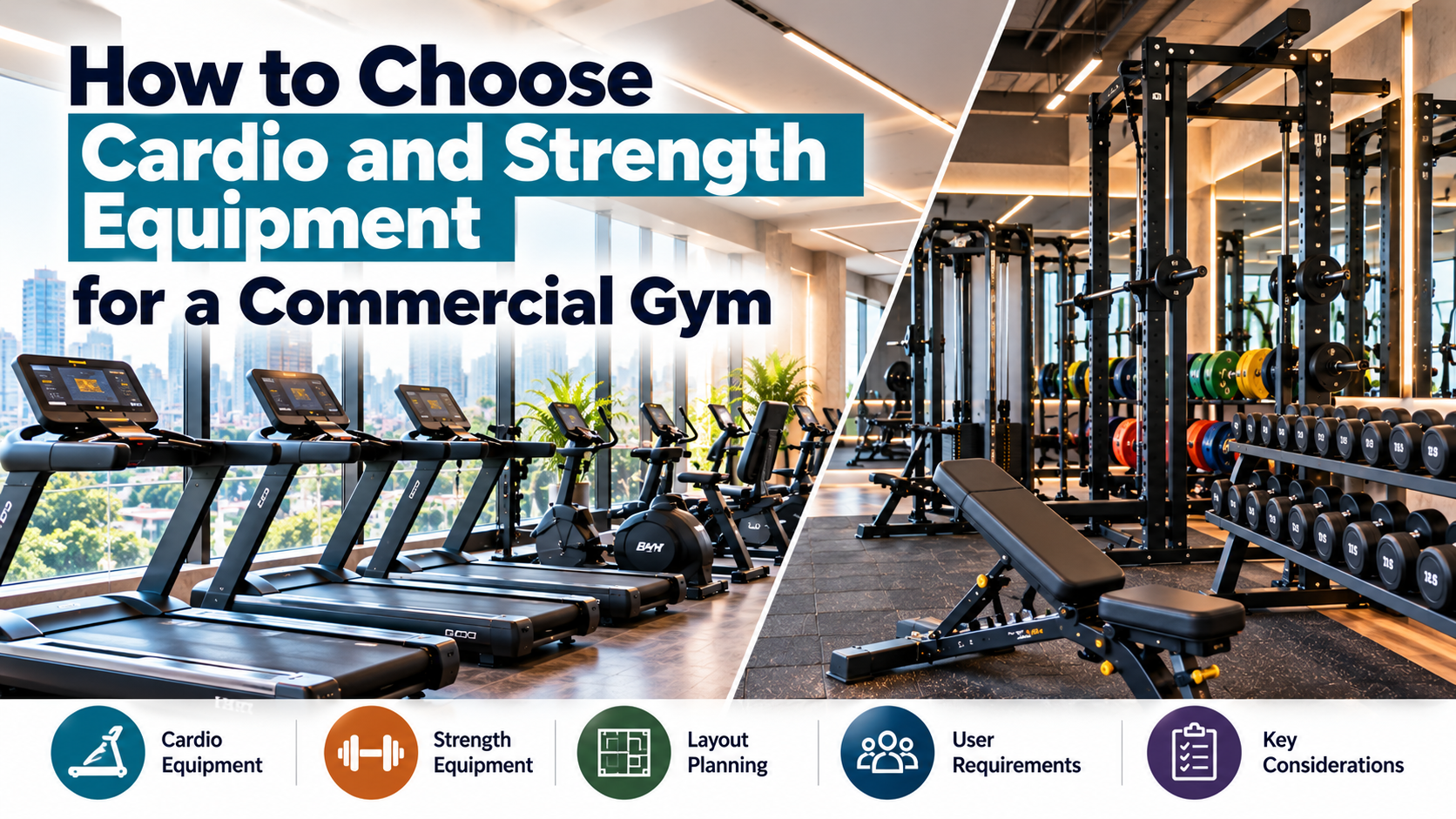
Choose cardio and strength equipment for a commercial gym according to the facility’s users, available floor area, training requirements and expected usage. Cardio equipment supports activities such as walking, running and cycling, while strength areas can combine machines, benches, racks and free weights depending on the facility.
There is no universal cardio-to-strength ratio. The correct equipment mix should be developed around the specific gym rather than copied from another facility.
Key Takeaways
- Define the gym’s users before selecting equipment.
- Plan cardio and strength zones against actual usable floor area.
- Avoid using a fixed cardio-to-strength ratio for every facility.
- Consider equipment variety as well as quantity.
- Allow enough room for circulation and equipment use.
- Check delivery and installation requirements before ordering.
- Build the equipment list around the facility’s purpose and budget.
What Is the Difference Between Cardio and Strength Equipment?
Cardio equipment is primarily designed for cardiovascular exercise and commonly includes equipment categories such as treadmills, exercise bikes and cross trainers.
Strength equipment is used for resistance training and may include selectorised machines, plate-loaded machines, benches, racks, free weights and related equipment.
A well-planned commercial facility may use both categories, but their relative importance depends on the gym’s users and operating model.
What Cardio Equipment Does a Commercial Gym Need?
A commercial gym may consider treadmills, exercise bikes, cross trainers and other appropriate cardiovascular equipment based on its users, space and training requirements.
The goal should not simply be to install the greatest possible number of cardio machines.
Consider:
- Who will use the equipment?
- What forms of cardio training are likely to be relevant?
- How much floor area can be allocated?
- Is sufficient circulation space available?
- How will the equipment fit with the strength area?
- What electrical or site requirements apply to the selected products?
The answers help determine an appropriate equipment mix.
Common Cardio Equipment Categories
Treadmills
Treadmills can support walking, jogging and running workouts.
When evaluating commercial treadmills, buyers should consider the intended environment, available floor area and manufacturer specifications for the products under consideration.
Electrical and positioning requirements should also be confirmed before installation.
Exercise Bikes
Exercise bikes provide another cardiovascular training option and can help create variety within the cardio zone.
The appropriate bike type and quantity depend on the users and facility rather than a universal formula.
Cross Trainers
Cross trainers can provide another form of cardio exercise and may complement treadmills and bikes in a mixed commercial facility.
As with other equipment, dimensions and technical requirements should be verified from current manufacturer documentation before finalising the layout.
What Strength Equipment Does a Commercial Gym Need?
A commercial strength area can include a combination of resistance machines and free-weight equipment selected according to the intended users and training environment.
Possible categories include:
- Selectorised strength machines
- Plate-loaded equipment
- Benches
- Racks
- Dumbbells
- Barbells and weight plates
- Functional-training equipment
- Storage systems
Not every gym needs every category.
A hotel fitness room may require a different strength setup from a membership-based gym designed for users with broader resistance-training requirements.
Selectorised vs Plate-Loaded Equipment
These categories serve different training and operational requirements.
| Category | General Planning Consideration |
|---|---|
| Selectorised equipment | Can provide guided resistance exercises and straightforward load selection |
| Plate-loaded equipment | Uses weight plates and may suit facilities where this training style is required |
| Free weights | Provide training flexibility but require appropriate floor area and storage |
| Benches and racks | Can support multiple exercises but need suitable working and safety space |
| Functional equipment | Can add training variety where sufficient open floor space is available |
The purpose of this comparison is not to identify one category as universally better. The correct choice depends on the gym.
How Much Cardio vs Strength Equipment Should a Commercial Gym Have?
There is no fixed cardio-to-strength ratio that is appropriate for every commercial gym.
The balance should be determined by:
- Facility type
- Floor area
- Expected membership or users
- Training preferences
- Operating model
- Available budget
- Existing or planned functional-training areas
For example, a compact hotel fitness room may prioritise a concise range of easily understood equipment, while a larger membership gym may require broader strength and free-weight options.
Equipment planning should respond to the project rather than an arbitrary percentage.
Choose Equipment According to Facility Type
Different facilities create different priorities.
| Facility Type | Equipment Planning Focus |
|---|---|
| Membership gym | Broader variety across cardio and strength categories |
| Hotel gym | Accessible equipment selection within the available space |
| Residential clubhouse | Balanced options for shared resident use |
| Corporate gym | Practical selection based on employees and available area |
| Resort gym | Balanced guest-focused fitness provision |
| Specialist training facility | Equipment aligned with its specific training model |
These are planning principles rather than fixed equipment lists.
Every project should still be assessed individually.
Start With the User Profile
Before asking which treadmill or strength machine to buy, ask who will use the facility.
- General fitness users
- Experienced gym users
- Hotel guests
- Residents
- Employees
- Personal-training clients
- Users interested primarily in strength training
- Users interested primarily in cardiovascular exercise
The expected audience influences the equipment mix.
A commercial facility serving a broad audience may need greater variety than a small fitness room designed for a narrower use case.
Plan the Gym in Zones
A useful commercial layout can divide the floor into functional areas.
Cardio Zone
Position relevant cardio equipment while accounting for circulation, power requirements where applicable and the overall layout.
Strength Machine Zone
Group appropriate strength equipment while maintaining practical movement between stations.
Free-Weight Zone
Allow sufficient room for benches, racks, dumbbells and other selected equipment.
Functional Training Zone
Where the facility requires functional training, retain enough open floor area rather than filling every available space with machines.
Mobility and Stretching Area
A dedicated or shared area can support stretching and mobility work.
Storage
Plan where plates, dumbbells, mats and other accessories will be stored.
Good storage is part of layout planning rather than something to solve after installation.
Avoid Overcrowding the Gym Floor
More equipment does not automatically make a commercial gym better.
Overcrowding can reduce:
- Circulation
- Usable training space
- Visual organisation
- Access to equipment
- Space for functional activity
The equipment schedule should therefore be reviewed alongside the floor plan.
Buyers developing a new facility can review Fitness Recall’s commercial gym equipment planning in Mumbai and turnkey gym project support for related planning considerations.
Compare Commercial Equipment Carefully
When comparing equipment, consider more than appearance.
Depending on the product category, useful questions include:
- Is the equipment intended for the required usage environment?
- Does it fit the allocated space?
- Is it suitable for the expected users?
- What manufacturer documentation is available?
- What installation requirements apply?
- What warranty information applies?
- How will future service enquiries be handled?
Product-specific technical claims should always be checked against current manufacturer documentation.
Consider Brand Options
Fitness Recall LLP has confirmed authorised-dealer relationships with:
- BH Fitness
- Tunturi Fitness
- California Fitness
The appropriate brand and equipment range depend on the project rather than simply choosing a brand name first.
Buyers can explore:
BH Fitness commercial equipment
The final equipment schedule should then be developed according to the facility’s actual requirements.
Think About Free Weights and Accessories Too
A cardio-and-strength plan should not overlook the supporting equipment needed to make the space practical.
Depending on the facility, this could include appropriate:
- Dumbbells
- Weight plates
- Bars
- Benches
- Storage
- Mats
- Functional-training accessories
Fitness Recall also supplies Jordan gym accessories.
Accessories should be selected according to the facility’s actual training requirements rather than added merely to increase the equipment list.
Check Delivery Before Finalising Equipment
Some equipment can be large and heavy, making access planning important.
Before placing an order, confirm:
- Building entrance
- Service entrance
- Door widths
- Corridor widths
- Stair access
- Lift availability and dimensions
- Floor level
- Route from unloading point to gym
- Site readiness
This is particularly important for upper-floor commercial gyms and properties with restricted access.
Consider Installation Requirements
Equipment should not arrive at a site that is unprepared for it.
Before installation, confirm relevant requirements involving:
- Flooring
- Electrical provision where applicable
- Equipment positions
- Access
- Site completion
- Storage
- Other contractors working in the area
The exact requirements depend on the selected equipment and project.
Build the Budget Around the Complete Equipment Mix
Commercial gym budgeting should consider the entire facility rather than individual machine prices in isolation.
A project budget may be influenced by:
- Equipment categories
- Number of units
- Brand selection
- Accessories
- Delivery
- Installation
- Flooring
- Site preparation
- Other project requirements
For more detail, see the guide to commercial gym setup cost in India.
Common Equipment-Selection Mistakes
Buying Before Measuring
Equipment should not be selected without understanding the usable floor area.
Copying Another Gym
A successful equipment mix for one facility may not suit another.
Using a Fixed Cardio-to-Strength Ratio
There is no universal ratio appropriate for every gym.
Ignoring Circulation
Equipment dimensions alone do not represent all the space required around a machine.
Forgetting Storage
Free weights and accessories require organised storage.
Ignoring Delivery Access
An equipment choice can create problems if the selected item cannot practically reach its final position.
Choosing Only on Price
Equipment suitability, project scope, installation, documentation and after-sales considerations should also form part of the comparison.
Frequently Asked Questions
What cardio equipment should a commercial gym have?
The appropriate cardio equipment depends on the facility’s users, floor area and training requirements. Common categories include treadmills, exercise bikes and cross trainers. Rather than following a universal list, choose equipment according to expected usage and the space available for the cardio zone.
What strength equipment does a commercial gym need?
A commercial strength area may include selectorised machines, plate-loaded equipment, benches, racks, free weights and functional-training equipment. The appropriate combination depends on the type of facility, intended users and available floor area.
What is the ideal ratio of cardio to strength equipment?
There is no universal ideal ratio. A hotel, corporate fitness room, residential clubhouse and membership gym can each require a different balance. Determine the mix from expected users, available floor area, training requirements and the overall operating model.
Should I choose equipment before designing the gym layout?
Equipment selection and layout planning should ideally happen together. The dimensions, training zones, circulation space, access and installation requirements can influence which equipment is suitable. Finalising machines before reviewing the floor plan can lead to overcrowding or an unbalanced facility.
Are free weights necessary in a commercial gym?
Free weights can be valuable for many commercial facilities, but the required range depends on the users and training model. They also require appropriate working space, flooring and storage, so they should be incorporated into the overall layout rather than added as an afterthought.
How do I avoid overcrowding a commercial gym?
Start with the usable floor area, define the required training zones and allocate equipment according to those zones. Maintain practical circulation and working space instead of attempting to fill every available area with machines.
How do I choose between different commercial gym equipment brands?
Compare brands according to the facility’s requirements, available equipment categories, manufacturer information, commercial terms, warranty documentation and supplier support. The brand should fit the project rather than the equipment plan being built around a brand name alone.
Planning Your Cardio and Strength Equipment Mix?
A suitable equipment schedule begins with your floor area, users, facility type and training requirements.
Fitness Recall LLP can discuss commercial gym equipment selection, layout planning, delivery and installation requirements for your project.